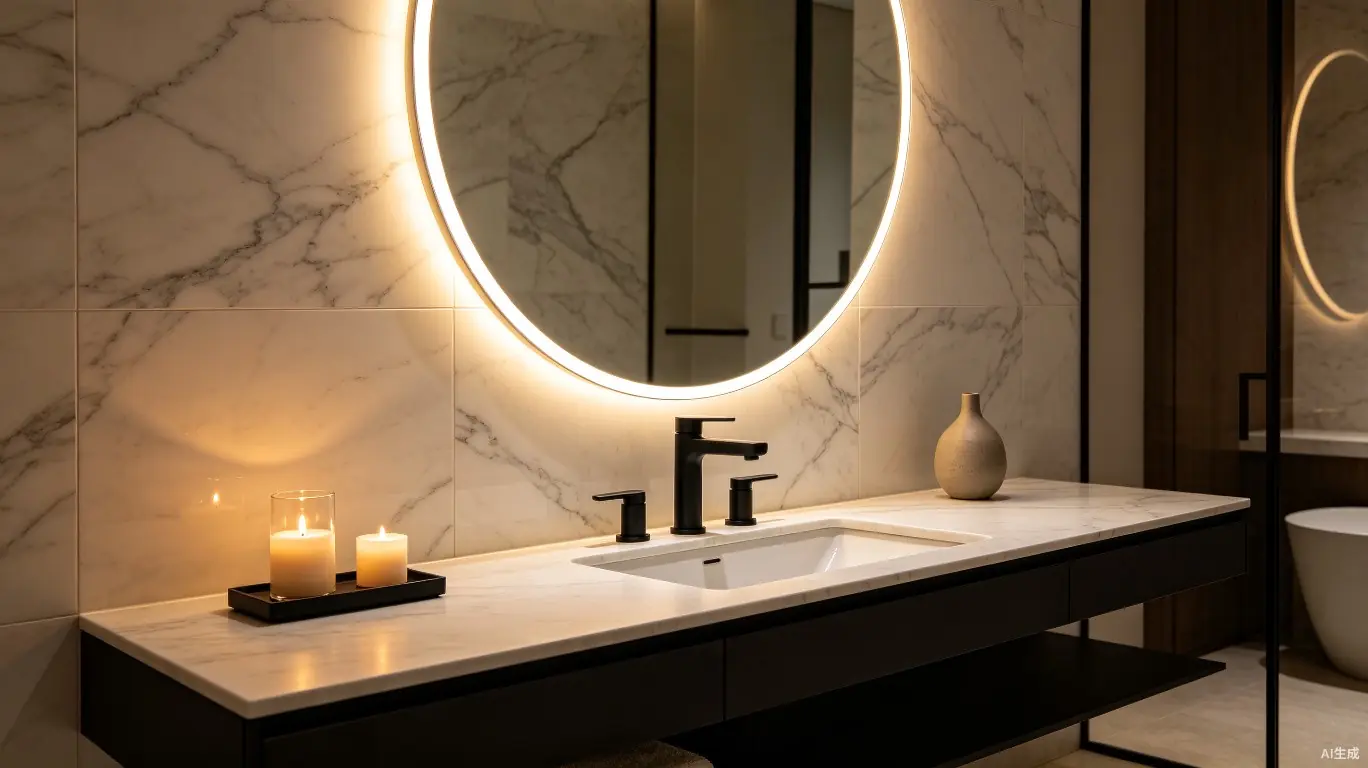

The bathroom mirror is far more than a reflective surface. It is the single most impactful visual element in a bathroom design, capable of making a small bathroom feel spacious, a dark bathroom feel bright, and a dated bathroom feel current. In 2026, mirror design trends reflect a convergence of smart technology, sculptural aesthetics, and thoughtful sizing that goes well beyond the standard builder-grade rectangle. Here are fourteen expert tips to guide your bathroom mirror selection and installation.
Size and Proportion
1. The mirror should span 70 to 80 percent of the vanity width for a single-sink configuration. A 30-inch-wide vanity calls for a mirror 21 to 24 inches wide; a 48-inch double vanity needs either two mirrors at roughly 18 to 20 inches each or a single large mirror at 34 to 38 inches. A mirror narrower than 70 percent of the vanity width looks undersized and diminishes the visual presence of the vanity itself.
2. Mirror height should start 4 to 6 inches above the vanity backsplash and extend at least 6 inches above the tallest user's eye level. For a household where the tallest user stands 6 feet tall (eye level at roughly 66 inches), the top of the mirror should reach at least 72 inches from the floor. This ensures everyone can see their full face without crouching. In bathrooms with 9-foot or taller ceilings, extending the mirror to within 12 inches of the ceiling creates a dramatic, vertical emphasis that makes the room feel taller.
3. Oversized mirrors from countertop to ceiling or from wall to wall are the single most effective trick for making a small bathroom feel larger. A mirror that spans the full width of the vanity wall, mounted so the bottom edge barely clears the backsplash and the top edge reaches the ceiling, visually doubles the perceived size of the room. This approach works especially well in powder rooms and half baths where the mirror serves no practical grooming function and can be treated as an architectural element.
Shape and Silhouette
4. Round and oval mirrors are the dominant shape trend for 2026, softening the hard lines of rectangular vanities, tile, and fixtures. A round mirror above a rectangular vanity creates a pleasing geometric contrast that feels both contemporary and timeless. For a 30-inch vanity, a 24-inch round mirror provides proper coverage; for a 48-inch vanity, consider two 20-inch round mirrors, one centered over each sink position.
5. Asymmetrical and organic-shaped mirrors are emerging as statement pieces in designer bathrooms. Irregular oval shapes, pill-shaped mirrors with rounded ends, and freeform organic silhouettes framed in thin metal add sculptural interest to what is typically a purely functional object. These shapes work best in bathrooms with otherwise clean, minimalist lines where the mirror becomes the focal point. Prices for designer irregular mirrors start at $300 and can exceed $2,000 for custom-sized pieces.
6. Arched and cathedral-top mirrors reference classical architecture and add a subtle traditional elegance to bathrooms of any style. The arched top softens the upper corners of the mirror and creates a gentle vertical emphasis. These mirrors pair particularly well with shaker-style vanities, brass fixtures, and marble countertops but can also provide a welcome counterpoint in ultra-modern bathrooms that need a touch of warmth.
Lighting Integration
7. LED backlit mirrors with integrated lighting have become the standard recommendation for any bathroom renovation in 2026. A backlit mirror provides shadow-free, even illumination for grooming while eliminating the need for separate vanity light fixtures and the electrical work they require. The LED strip runs behind the mirror glass, projecting light onto the wall to create a soft halo effect. Quality backlit mirrors with a CRI of 90+, color temperature adjustable between 3,000K and 6,000K, and an anti-fog heating pad cost $200 to $800 depending on size.
8. Front-lit mirrors with built-in LED strips on the face of the glass provide more direct facial illumination than backlit models. Many 2026 models offer dual lighting — both a front-lit face ring for task lighting and a backlit halo for ambient effect — switchable independently. For makeup application and detailed grooming, front-lit mirrors are superior to backlit-only models, but they require the LED strip to be diffused behind a frosted border to avoid harsh glare.
9. Smart mirrors with integrated displays, Bluetooth speakers, and voice assistant connectivity are gaining traction, but their value proposition depends heavily on your morning routine. A smart mirror that displays weather, calendar, and news headlines while you brush your teeth can genuinely streamline your morning, but the screen area reduces the usable mirror surface. For shared bathrooms, prioritize a model where the smart display occupies less than 20 percent of the total mirror area.
Framing and Finishing
10. Frameless mirrors with polished, beveled edges remain the most versatile choice and the safest bet for resale value. A 1-inch bevel on a frameless mirror catches and reflects light, adding a subtle sparkle and visual weight to the edge. Frameless mirrors should be at least one-quarter inch thick for durability; three-sixteenths-inch mirrors are prone to warping and produce a slightly distorted, funhouse reflection that is unacceptable for a primary bathroom.
11. Thin metal frames in matte black, brushed brass, or polished nickel add definition without bulk. A 0.5- to 1-inch-wide frame provides a crisp border that helps the mirror read as an intentional design element rather than an unadorned sheet of glass. The frame finish should match the primary metal finish used for the faucet, towel bars, and cabinet hardware to create a cohesive look. Mixing metal finishes in the same bathroom is possible but requires at least two elements in each finish to avoid looking accidental.
12. Wood-framed mirrors bring warmth and organic texture to bathrooms that risk feeling cold and clinical. A solid teak or white oak frame with a moisture-resistant finish can withstand bathroom humidity for decades if properly sealed. Wood-framed mirrors work especially well in Japandi, rustic, and mid-century modern bathrooms. For maximum moisture resistance, look for frames made from engineered teak or acetylated wood, which are dimensionally stable in high-humidity environments.
Installation and Practical Details
13. Mirror mounting height should position the reflective surface where it is most useful, not necessarily centered on the wall. The center of the mirror should align with the average eye level of household members, typically 58 to 62 inches from the floor. In bathrooms used by both adults and children, consider a tilt mirror — a mirror mounted on adjustable brackets that can be angled downward for shorter users — or a secondary full-length mirror mounted elsewhere in the bathroom.
14. Anti-fog technology is worth the investment for any bathroom mirror in a space without excellent ventilation. Heated mirror pads that warm the glass surface to slightly above room temperature prevent condensation from forming after showers. These pads adhere to the back of the mirror, connect to a 110-volt power source, and consume roughly 30 to 60 watts. For existing mirrors, aftermarket anti-fog film kits cost $40 to $80 and can be installed in under an hour with basic tools.