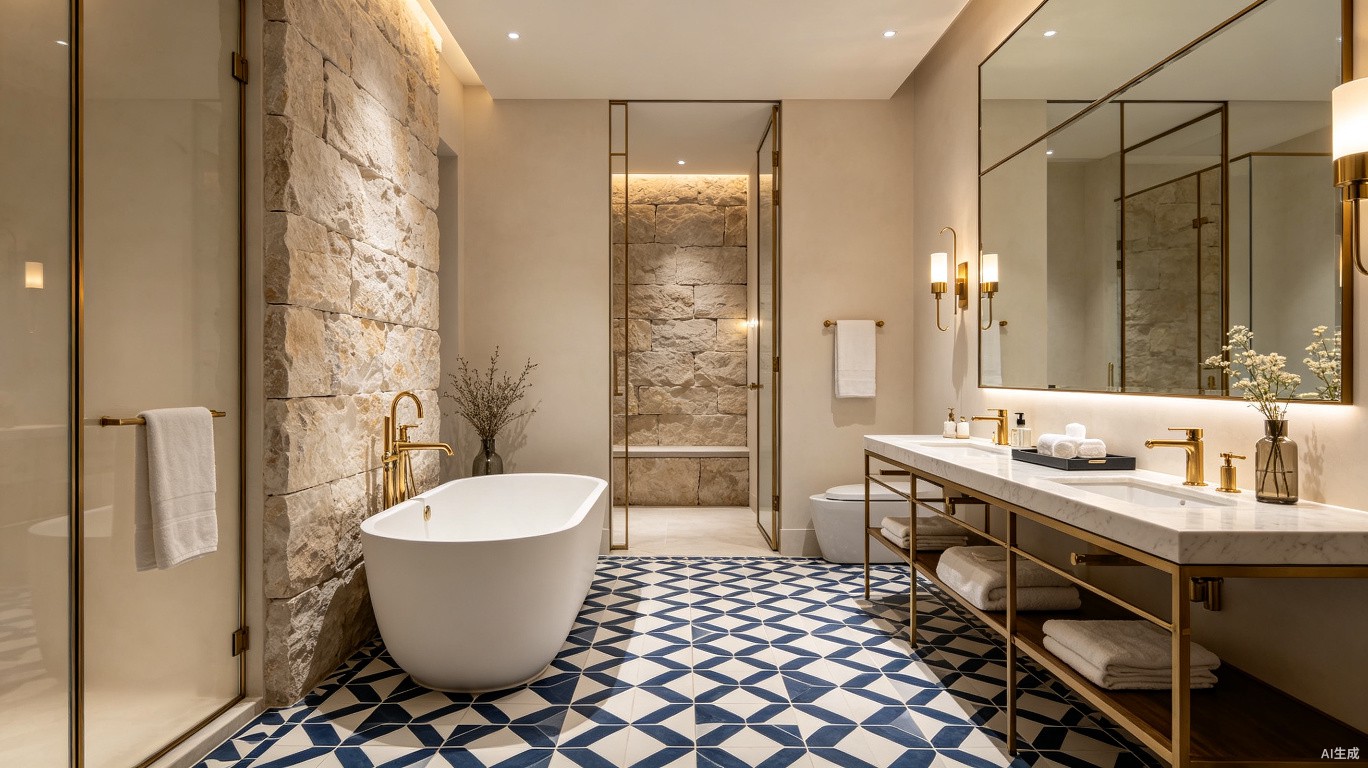

The pattern in which you lay bathroom tile is arguably more important than the tile itself. A basic white subway tile can look pedestrian in a standard running bond, but the same tile installed in a vertical stack or herringbone pattern reads as deliberate and design-forward. Conversely, an expensive marble mosaic loses its impact when the layout feels chaotic or poorly planned. Tile pattern determines how the eye moves across the room, influences the perception of the bathroom's proportions, and sets the entire design tone before you have added a single fixture or accessory. This guide covers fifteen tile patterns, explaining what each does for your space and where it works best.
Classic Patterns and Their Effects
1. The running bond, or brick pattern, is the most common tile layout for good reason —it is forgiving, timeless, and works with virtually any rectangular tile. Each tile overlaps the seam of the tile below by 50 percent, creating a staggered effect that conceals slight variations in tile size or wall unevenness. A standard 3-by-6-inch subway tile in running bond suits traditional, transitional, and farmhouse-style bathrooms. For a subtle update, consider an offset of 30 to 40 percent rather than the standard 50 percent, which creates a more organic, less regimented look that is trending in 2026.
2. The stacked bond pattern, where tiles align in both horizontal and vertical rows with no offset, creates a clean, grid-like appearance that suits modern and minimalist bathrooms. This pattern requires more precise tile sizing than running bond —even a 1mm variation between tiles becomes visible in the continuous grout lines. Large-format tiles, 12 by 24 inches or larger, are ideal candidates for stacked bond because fewer grout lines mean a sleeker appearance. The stacked bond emphasizes the height of a wall, making it a clever choice for bathrooms with low ceilings.
3. The vertical stack is a rising trend in 2026 bathroom design. By rotating the stacked bond 90 degrees, the grout lines run vertically rather than horizontally, which draws the eye upward and makes the ceiling feel higher. This pattern works exceptionally well with subway tiles installed vertically on a single accent wall —the shower wall is the most common choice. Vertical stack in a dark grout against light tiles creates a dramatic striped effect that reads as architectural rather than decorative.
Angled and Diagonal Patterns
4. The herringbone pattern remains one of the most requested bathroom tile layouts, and for good reason —its dynamic zigzag creates movement and visual energy that static patterns cannot match. Herringbone requires tiles with a length-to-width ratio of at least 2:1; 3-by-6-inch and 4-by-12-inch tiles are the most common proportions. The pattern generates approximately 15 percent more material waste than a straight lay due to the cuts required at the edges, so order accordingly. Herringbone on the floor in a small bathroom can make the space feel busier, so consider reserving it for a feature wall or the shower niche.
5. Chevron is herringbone's more precise cousin. Unlike herringbone, where rectangular tiles interlock at 90-degree angles with staggered ends, chevron tiles are cut at an angle —typically 45 degrees —so they meet at a perfect point, creating a continuous V-shaped pattern. The visual difference is subtle but meaningful: chevron reads as more formal and controlled, making it suitable for upscale, hotel-inspired bathrooms. Chevron tiles must be cut specifically for the pattern, which adds to the material cost, but the result is a seamless zigzag with no exposed tile ends.
6. A diagonal, or diamond, pattern rotates the standard grid by 45 degrees, so tiles appear as diamonds rather than squares. This layout tricks the eye into perceiving a larger floor area because the diagonal lines lead the gaze toward the corners of the room. Diagonal layouts are particularly effective in small bathrooms and powder rooms, where they can make a cramped floor feel more expansive. The trade-off is that diagonal layouts generate roughly 20 percent more waste due to the angled cuts required along every wall. For the best result, the center of the room should feature a full tile or an intersection of grout lines.
Mosaic and Decorative Patterns
7. Basketweave is a classic mosaic pattern that alternates horizontal and vertical rectangular tiles in pairs, mimicking the over-under weave of a basket. Traditionally executed in small marble tiles —typically 1 by 2 inches or 2 by 4 inches —basketweave adds texture and historical reference to a bathroom floor. It is an excellent choice for traditional and transitional bathrooms, but the small tile size means more grout lines and, consequently, more maintenance. Sealing the grout annually is essential to prevent staining on a basketweave floor.
8. Hexagon tiles in a honeycomb pattern have been trending for several years and remain popular in 2026. The six-sided shape creates a geometric rhythm that is visually interesting without being busy. Small hexagons —2 inches or less —are best suited for floors, where the pattern reads as a mosaic. Large-format hexagons, 8 inches or larger, work on both floors and walls and have a more contemporary feel. When using hexagons on the floor, plan the layout to center the pattern on the most visible area, typically the space in front of the vanity.
9. Penny round mosaics, composed of small circular tiles typically 0.75 to 1 inch in diameter, create a delightful, retro-inspired surface with excellent slip resistance due to the high density of grout lines. Penny rounds are most commonly used on bathroom floors, where the texture underfoot feels pleasant and the pattern adds visual interest without overwhelming the space. A dark grout with white penny rounds creates a bold contrast, while a matching grout produces a more subtle, unified surface. Penny rounds are available in porcelain, ceramic, and natural stone, with porcelain being the most durable and affordable at $5 to $15 per square foot.
Modern and Architectural Patterns
10. Large-format tiles —24 by 48 inches or even 48 by 48 inches —create the fewest grout lines of any layout, resulting in a nearly seamless surface that feels luxurious and contemporary. These tiles require a perfectly flat substrate; any unevenness in the wall or floor will cause lippage, where adjacent tiles sit at different heights. The large format trend continues to grow in 2026, with porcelain slabs up to 60 by 120 inches now available for the most ambitious installations. Large-format tiles cost more to install —expect to pay $12 to $25 per square foot for labor —but the dramatic result is hard to achieve with conventional tiles.
11. The offset grid, also called a one-third or one-quarter offset, staggers tiles by 33 or 25 percent rather than the 50 percent of a running bond. This subtle shift creates a more contemporary, less predictable rhythm while retaining the installation ease of a staggered layout. The one-third offset is recommended for large-format rectangular tiles because it minimizes the lippage that can occur with a 50 percent offset when tiles have a slight bow —a common issue with tiles longer than 15 inches.
Accent and Feature Wall Strategies
12. A feature wall in a contrasting tile pattern creates a focal point in the bathroom without overwhelming the space. The shower wall behind the fixtures is the most natural location for a feature wall, as it anchors the room visually. A herringbone or chevron pattern on the feature wall, with the remaining walls in a simple stacked or running bond, provides visual interest without the cost and complexity of tiling the entire bathroom in an intricate pattern. The transition between the feature wall and surrounding walls should be clean and intentional —metal tile edging in a finish that matches the fixtures provides a crisp boundary.
13. A tile rug —a bordered section of decorative tile on the bathroom floor —defines the vanity area and adds a custom, furniture-like detail. The border can be a single row of contrasting tile or a thin pencil liner that frames a patterned mosaic field. This technique works best in larger bathrooms where the vanity area is visually separate from the shower and toilet zones. The tile rug should be centered on the vanity, extending 6 to 12 inches beyond it on each side.
Grout and Color Considerations
14. Grout color is a design decision that transforms how a tile pattern reads. A matching grout minimizes the visual impact of the grout lines, making the tile pattern recede and the overall surface feel more unified —ideal for busy patterns like herringbone where you want the tile, not the grid, to be the focus. A contrasting grout, such as dark gray with white tile, emphasizes the pattern geometry and turns the layout itself into the design statement. Contrasting grout works best with simple, bold patterns like stacked bond or running bond, where the grid lines become graphic and architectural.
15. Epoxy grout, while more expensive and demanding to install, is the best choice for bathroom floors and shower walls. It is stain-resistant, waterproof, and does not require sealing —three advantages over traditional cement-based grout that directly affect the long-term appearance of your tile pattern. Cement grout in a bathroom floor absorbs moisture and discolors over time, turning a once-crisp pattern into a dingy, uneven surface. Epoxy grout costs roughly 50 percent more than cement grout, adding $2 to $5 per square foot to the installation cost, but its durability makes it a worthwhile investment for bathrooms that see daily use.