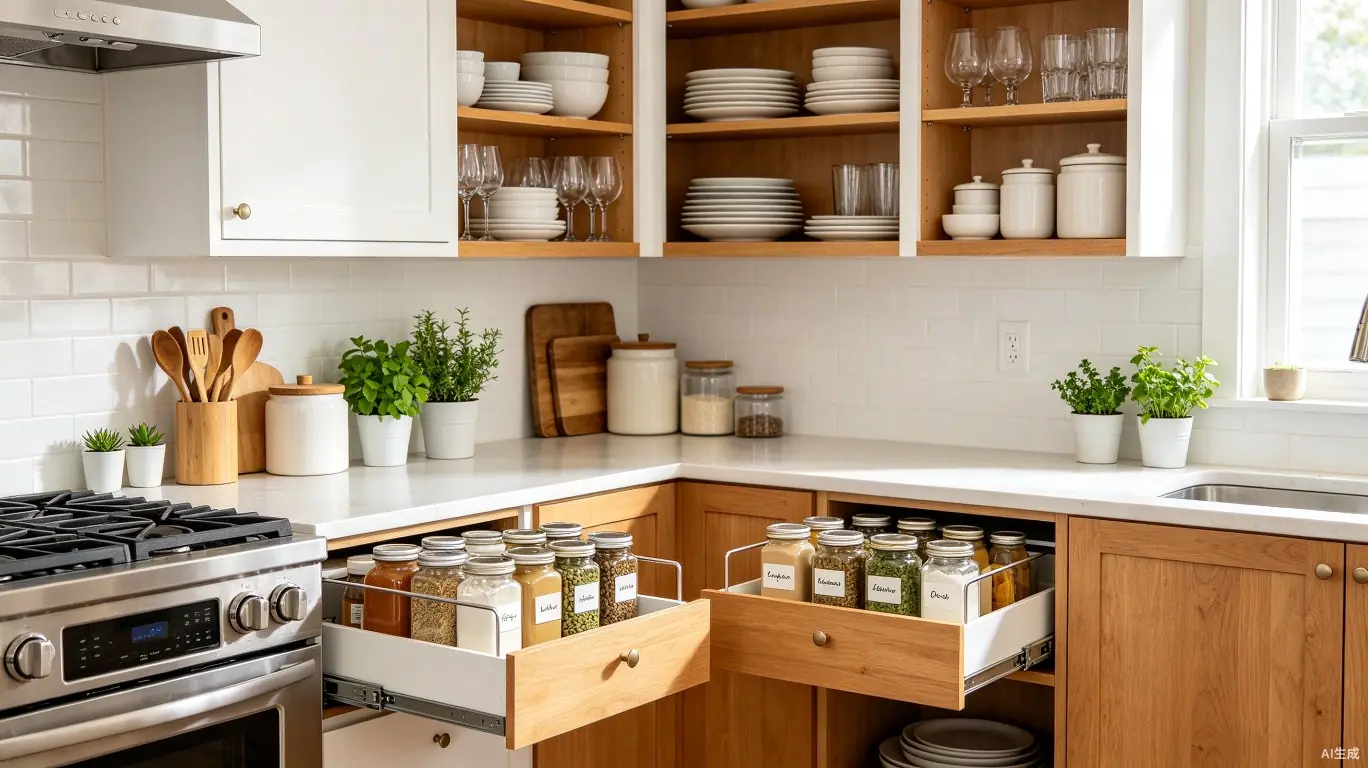

An organized kitchen is not just about aesthetics — it directly impacts how efficiently you cook, how much food you waste, and how much time you spend searching for things. The average home cook wastes approximately 15 minutes per meal session looking for ingredients and tools in disorganized cabinets. Over a year, that adds up to more than 180 hours. Professional kitchen organization is about creating systems that make everything visible, accessible, and logical. Here are fifteen practical, proven strategies to transform your kitchen cabinets from chaos to order.
Zone-Based Organization
1. Establish five core kitchen zones and assign every cabinet to one zone. The prep zone (near the sink) stores cutting boards, knives, mixing bowls, and measuring tools. The cooking zone (near the stove) holds pots, pans, spatulas, oils, and spices. The storage zone stores dry goods, canned items, and bulk ingredients. The cleaning zone (under and around the sink) keeps dish soap, sponges, garbage bags, and cleaning supplies. The serving zone (near the dining area) holds plates, glasses, flatware, and serving dishes. Organizing by zone rather than by item type reduces cross-kitchen trips during cooking by up to 40 percent.
2. Store items at their point of first use. Coffee mugs belong in the cabinet closest to the coffee maker, not necessarily with other drinkware. Cooking oils and frequently used spices should be within arm's reach of the stove — a pull-out spice rack in a base cabinet adjacent to the range is ideal. Potholders and trivets belong in a drawer directly below or next to the oven. This "first-use proximity" principle is the foundation of professional kitchen design and requires no additional products, only a thoughtful rethinking of your existing cabinet layout.
Drawer Systems and Inserts
3. Replace lower cabinet shelves with deep drawers wherever possible. Pull-out drawers in base cabinets eliminate the need to kneel and reach into dark corners, making every item visible and accessible with a single motion. Drawers should be at least 21 inches deep (standard base cabinet depth) and rated for 100 to 150 pounds to hold stacks of plates, pots, and small appliances. If full cabinet replacement is not in the budget, roll-out tray inserts that mount to existing shelves provide similar functionality for $30 to $60 per shelf.
4. Drawer dividers are non-negotiable for utensil and tool organization. Adjustable bamboo or plastic dividers that can be reconfigured as your tool collection changes are more versatile than fixed-compartment trays. For a standard 18-inch-wide utensil drawer, a four- to six-compartment layout separates cooking utensils (spatulas, tongs, ladles), prep tools (peelers, graters, measuring spoons), and serving pieces. The dividers prevent tools from sliding and jamming the drawer when it opens and closes.
5. Pegboard drawer inserts for pots and pans are a game-changing organization system that costs under $40. A sheet of pegboard cut to fit the drawer dimensions, combined with wooden dowels cut to 2-inch lengths, creates a fully customizable divider system. Arrange the pegs around each pot and pan to hold it in place, preventing the stack from shifting when the drawer opens. This system is infinitely reconfigurable as your cookware collection changes and costs a fraction of commercial pot-and-pan organizer systems.
Shelf Optimization
6. Shelf risers double the usable space in upper cabinets. A simple wire or bamboo riser creates a second tier of storage, allowing you to see and access items in the back without unstacking everything in front. For standard 12-inch-deep upper cabinets, a 5-inch-deep riser leaves 7 inches of accessible space on the lower level for taller items like cereal boxes and large spice containers. Risers cost $10 to $25 each and are most effective in cabinets storing plates, bowls, canned goods, and spice collections.
7. Lazy Susan turntables belong in corner cabinets and deep pantry shelves. A two-tier lazy Susan in a corner base cabinet turns an awkward, hard-to-access dead zone into a highly functional storage area. For blind corner cabinets, kidney-shaped lazy Susans that rotate independently of the door provide full access to every inch. In pantry cabinets, a 12-inch lazy Susan on each shelf keeps items from being pushed to the back and forgotten. Quality lazy Susans with ball-bearing rotation mechanisms cost $25 to $60 and last for decades.
8. Vertical dividers mounted inside cabinets transform the space above shelves into organized storage for baking sheets, cutting boards, cooling racks, and platters. A simple set of tension-mounted or screw-in vertical dividers spaced 2 to 3 inches apart keeps these flat items upright and accessible — no more stacking and unstacking to reach the one sheet pan at the bottom. This solution is most effective in a base cabinet near the oven or prep zone and costs $15 to $30 for a set of dividers.
Container and Labeling Systems
9. Decant dry goods into uniform, airtight containers. Transferring flour, sugar, rice, pasta, cereal, and snacks from their original packaging into clear, stackable containers with airtight seals serves three purposes: it extends shelf life by protecting against moisture and pests, it makes inventory visible at a glance so you know when to restock, and it eliminates the visual chaos of mismatched packaging. Square or rectangular containers maximize cabinet space — round containers waste roughly 20 percent of shelf space compared to their square counterparts of the same volume.
10. Label everything, including containers and shelf edges. Labels eliminate the "which container has the powdered sugar and which has the cornstarch" guessing game and make it possible for other household members to find and return items without your help. A simple label maker with clear tape ($25 to $50) is the best investment; handwritten masking tape labels degrade quickly and look sloppy. For shelf edges, label the home position of each category of item — "Pasta & Grains," "Canned Vegetables," "Baking Supplies" — to maintain the system over time.
Door-Mounted and Under-Shelf Storage
11. Cabinet door-mounted organizers reclaim the unused space on the inside of cabinet doors. Over-the-door wire racks hold pot lids, cutting boards, plastic wrap, aluminum foil, and cleaning supplies without consuming shelf space. When selecting door-mounted organizers, measure the interior depth of the cabinet and ensure the organizer plus its contents do not prevent the door from closing fully. Most door-mounted racks require 2 to 3 inches of interior clearance beyond the shelf contents.
12. Under-shelf baskets that clip onto existing shelves create instant additional storage without any installation. These wire baskets hang below a shelf and are ideal for lightweight items like dish towels, snack bags, napkins, and small food storage containers. They add roughly 3 to 4 inches of storage depth below an existing shelf and cost $8 to $15 each. Avoid loading them with heavy items — the clip mechanism is designed for light loads and will sag or detach under excessive weight.
Maintenance and Habits
13. The "one in, one out" rule prevents cabinet clutter from creeping back. For every new kitchen tool, gadget, or small appliance you bring into the kitchen, one comparable item must leave. This rule is especially important for categories prone to accumulation: coffee mugs, water bottles, food storage containers, and novelty gadgets. A twice-yearly cabinet audit — once in spring and once in fall — catches items that have slipped through and keeps the system functioning.
14. Group like items by frequency of use, not by type alone. The everyday dishes, glasses, and coffee mugs should occupy the most accessible shelves — typically the lowest shelf in upper cabinets and the top drawer in base cabinets. Special-occasion serving platters, holiday bakeware, and infrequently used appliances belong on high shelves or in deep base cabinets. If you need a step stool to reach something, it should be an item you use less than once a month.
15. Take a "before" photo of your organized cabinets. It sounds trivial, but this visual reference is the single most effective tool for maintaining organization over time. When cabinets inevitably start to drift from their organized state, the photo provides an instant reference for how things should look. Set a recurring calendar reminder every three months to spend 15 minutes restoring cabinets to their documented organized state. Fifteen minutes of quarterly maintenance prevents the multi-hour deep cleans that disorganized cabinets eventually require.