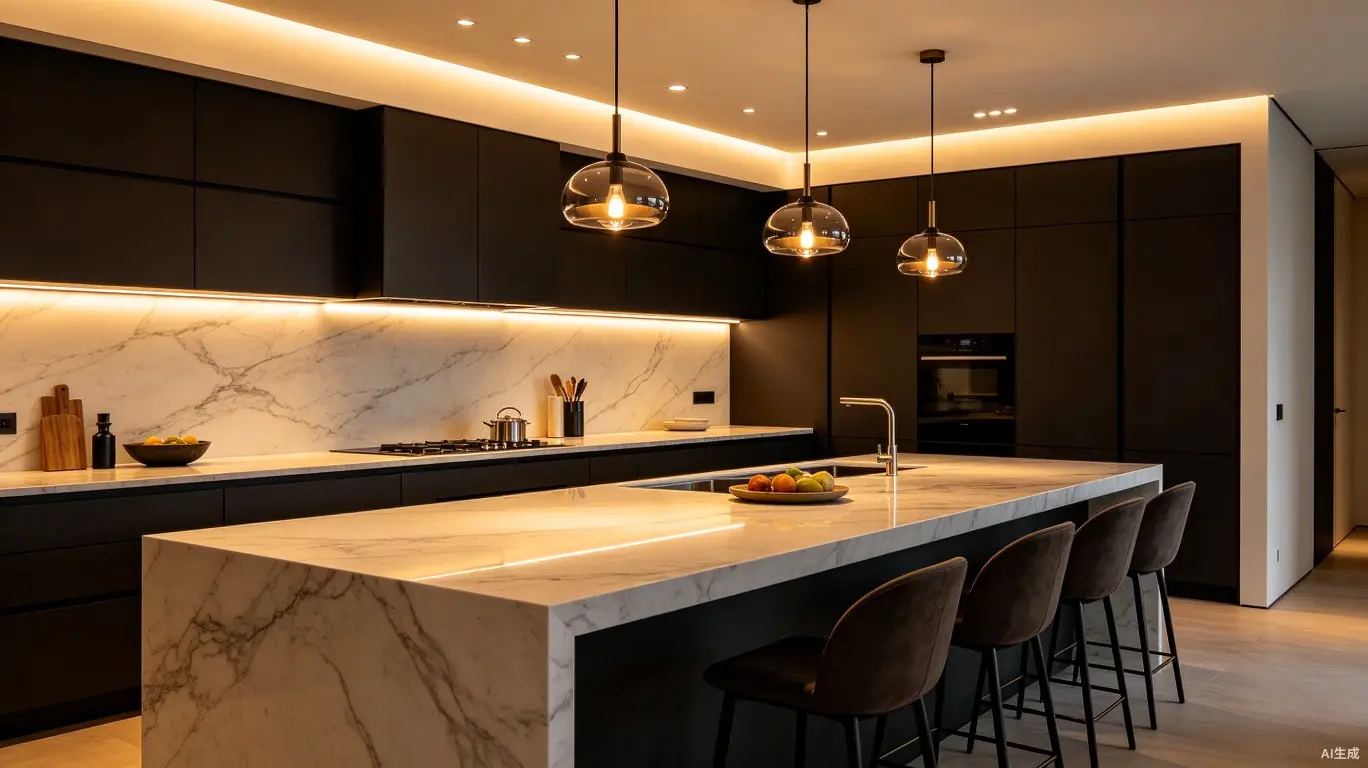

Kitchen lighting is the most technically demanding illumination challenge in any home. A kitchen requires three distinct layers of light: task lighting so you can see what you are chopping, ambient lighting to fill the room, and accent lighting to highlight architectural features. Here are fourteen professional tips for getting every layer right.
The Three-Layer System
1. The foundational principle of kitchen lighting is layering: ambient light provides overall illumination, task light illuminates specific work areas, and accent light adds visual depth. No single fixture can serve all three functions. Every successful kitchen lighting plan incorporates at least three separate circuits for independent control.
2. Ambient lighting should provide 300 to 400 lux across the entire kitchen floor area. This typically requires one recessed fixture per 1.5 to 2 square meters of ceiling area. Fixtures should be arranged in a grid pattern with equal spacing. LED recessed lights with a beam angle of at least 90 degrees provide the most even coverage.
Task Lighting That Works
3. Under-cabinet lighting is essential, not optional. The human body standing at a counter creates a shadow directly over the work surface if the only light source is overhead. Under-cabinet LED strips eliminate this shadow, directing 400 to 500 lux onto the countertop. Hardwired fixtures mounted at the front of the cabinet are most effective.
4. The color temperature of kitchen task lighting should be 3,500K to 4,000K -- neutral to cool white that renders food colors accurately. This range is critical for food preparation: red meat appears properly red, vegetables look fresh, and you can judge doneness by sight. Avoid 2,700K warm white for task areas.
5. Island pendant lights serve dual duty. The bottom of pendant fixtures should hang 75 to 90 centimeters above the island countertop. Higher placement scatters light and creates glare; lower placement obstructs sight lines. For a 2.5-meter island, three pendants spaced 60 to 75 centimeters apart achieve balanced illumination.
Accent and Mood Lighting
6. Toe-kick lighting -- LED strips at the base of cabinets -- transforms a kitchen at night. This low-level light provides safe navigation without jarring brightness and creates a floating cabinet effect. Motion-sensor toe-kick lights automatically activate when someone enters after dark.
7. In-cabinet and in-drawer lighting elevates everyday usability. Glass-front upper cabinets illuminated from within turn dishware into display pieces. Deep drawers with automatic LED strips eliminate the frustration of rummaging through dark corners. The cost to add cabinet interior lighting is $300 to $800.
Fixture Selection and Placement
8. Recessed downlight spacing follows a simple formula: distance between fixtures equals ceiling height divided by two. For standard 2.4-meter ceilings, that means 1.2 meters between fixtures. Fixtures should be at least 60 centimeters from walls to avoid harsh shadows on vertical surfaces.
9. Chandeliers over dining tables should be sized at half to two-thirds the width of the table. A 1.2-meter-wide table calls for a fixture 60 to 80 centimeters wide. The bottom should hang 75 to 85 centimeters above the table -- low enough for intimate light, high enough for sight lines.
Controls and Smart Features
10. Dimmers belong on every kitchen light circuit. A kitchen needs bright light for cooking (400 to 500 lux) and soft light for dining (50 to 150 lux). Dimmers bridge this gap and extend LED fixture life. Smart dimmers that learn your patterns and adjust color temperature automatically cost $40 to $60 per switch.
11. Scene-based lighting control allows saving configurations with a single tap: a "cooking" scene with all task and ambient lights at full brightness, a "dining" scene with dimmed task lights and raised accent lights, and a "night" scene with only toe-kick and minimal ambient lighting.
Color Temperature Strategy
12. A single kitchen should use consistent color temperature across all ambient fixtures. However, task and accent lighting can differ strategically. Combining 4,000K under-cabinet task lighting with 3,000K ambient recessed lighting and 2,700K pendant lights creates a sophisticated layered effect.
13. All kitchen lighting should be planned before drywall installation. Retrofitting recessed lights and under-cabinet wiring after walls are closed adds 50% to 100% to the cost. The lighting plan should be finalized at the same time as the cabinet layout, as the two are interdependent.
14. The Color Rendering Index (CRI) matters enormously for LED fixtures. A CRI of 90 or above means colors appear nearly identical to natural daylight. Below 80 CRI, food appears unappetizing and skin tones look sickly. For kitchens, also verify the R9 value (red rendering) is above 50.