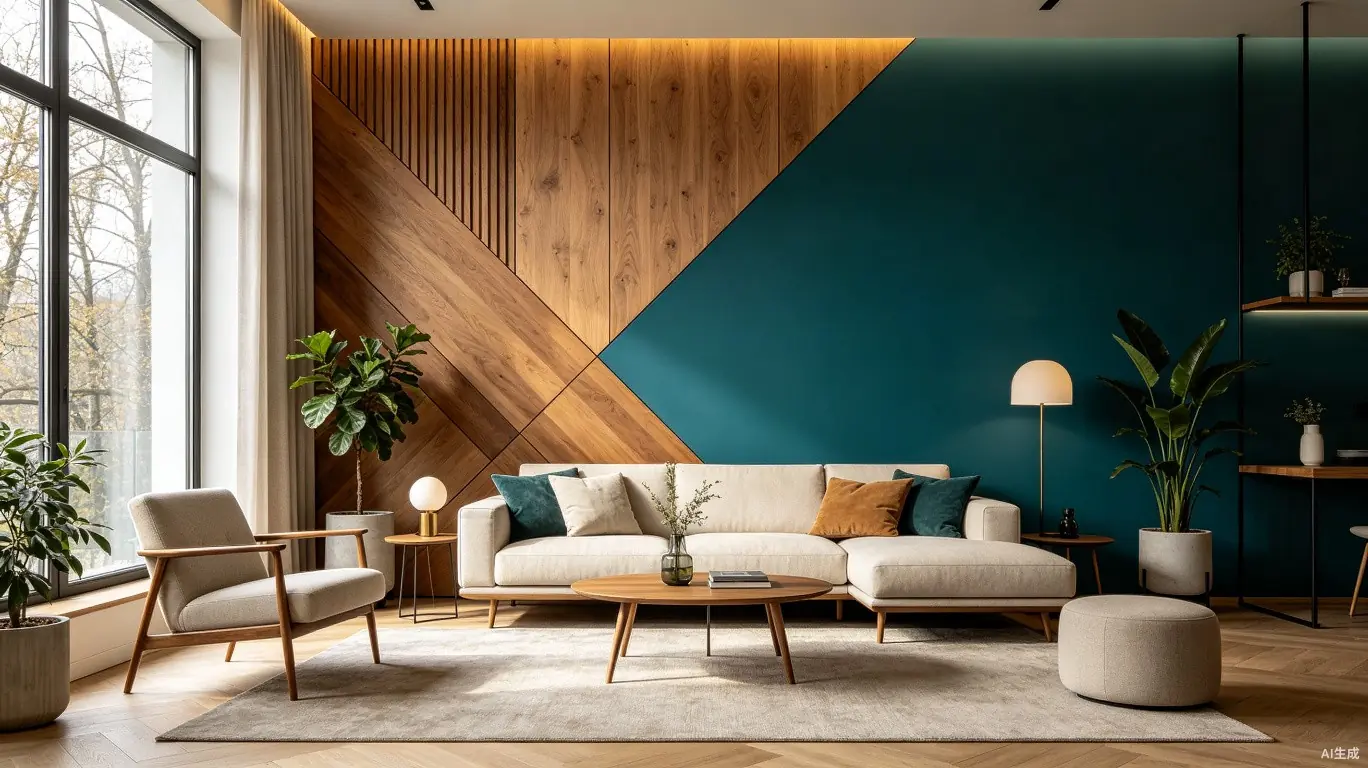

An accent wall is the single most cost-effective way to transform a living room. For the price of a gallon of paint or a few rolls of wallpaper, you can completely change how the room feels, draws the eye, and communicates personality. But not all accent walls are created equal. Choosing the wrong wall, the wrong color, or the wrong material can make a room feel unbalanced instead of elevated. Here are fifteen expert tips, drawn from real project experience, to help you design an accent wall that adds genuine architectural character to your living space.
Choosing the Right Wall
1. The accent wall should always be the first wall you see when entering the room. This is typically the wall behind the sofa, the wall facing the entry door, or the wall with a fireplace. The goal is to establish a natural focal point that the eye gravitates toward immediately. Avoid accenting a wall that is partially obscured by furniture or that sits perpendicular to the primary sightline — it will feel disconnected from the room's visual flow.
2. Avoid accenting a wall with a window or door unless you are deliberately framing an architectural feature. Windows break up the surface area and compete for attention, diluting the impact of the accent treatment. If your only uninterrupted wall is smaller or less prominent, treat it as an opportunity for a more intimate, jewel-box effect rather than a grand statement.
3. In open-concept spaces, use the accent wall to define zone boundaries. A painted accent wall on the living room side of an open floor plan signals where the living zone begins without the need for physical partitions. Choose a color that complements but contrasts with the adjacent dining or kitchen zone to reinforce the spatial distinction. This technique is especially effective in lofts and combined living-dining areas where walls are shared.
Color Selection Strategy
4. Deep, saturated colors work best for accent walls in rooms with abundant natural light. Charcoal, navy, forest green, and deep burgundy create dramatic depth without closing in the space, provided the room receives at least four to six hours of daylight. In low-light rooms, opt for mid-tone warm colors like terracotta, mustard, or olive green. Dark colors in dim rooms can feel oppressive rather than cozy, and the accent effect is lost when shadows obscure the color.
5. The 60-30-10 color rule provides a reliable framework: 60 percent of the room in a dominant neutral (typically walls and large furniture), 30 percent in a secondary color (the accent wall plus coordinating textiles), and 10 percent in an accent color (accessories and art). The accent wall anchors the 30 percent layer and should relate to at least two other elements in the room — throw pillows, a rug, or drapery panels in the same color family.
6. Test paint colors on the actual wall before committing. Paint a 24-by-24-inch swatch and observe it at different times of day — morning, noon, and evening under artificial light. Colors can shift dramatically based on the wall's orientation. North-facing walls receive cool, bluish light that can make warm colors look muddy; south-facing walls get warm, yellow light that can oversaturate already-bold colors. A color that looks perfect on a paint chip at the store may read entirely differently on your wall.
Material and Texture Approaches
7. Wood slat accent walls, particularly vertical slats in oak or walnut, are the most requested accent wall treatment in 2026. The slats add warmth, texture, and a subtle mid-century modern reference that works with nearly every design style. Standard slat dimensions are 1.5 to 2 inches wide with 0.5- to 0.75-inch gaps, mounted on a black felt or acoustic backing for sound absorption. A slat wall covering an 8-by-10-foot wall costs $400 to $800 in materials for DIY installation, or $1,200 to $2,500 with professional installation.
8. Wallpaper accent walls offer pattern possibilities that paint cannot match. In 2026, large-scale botanical prints, abstract geometrics, and textured grasscloth are leading wallpaper trends. When selecting wallpaper, order at least 15 percent more than your measured square footage to account for pattern matching and mistakes. Prep the wall with a primer-sealer before hanging to ensure clean removal down the line — a step that DIYers frequently skip and later regret.
9. Textured plaster and limewash finishes create an old-world, artisanal look that is surging in popularity. Unlike flat paint, limewash has subtle color variation and a chalky, matte texture that shifts with the light throughout the day. Application requires a specialty contractor — expect to pay $8 to $15 per square foot — but the result is a one-of-a-kind surface that paint cannot replicate. Limewash is also naturally mold-resistant and breathable, making it a healthy choice for interior walls.
10. Stone veneer and brick accent walls bring architectural weight to a living room. Faux stone panels made from high-density polyurethane have improved dramatically in realism over the past five years and can be installed as a DIY project for $6 to $12 per square foot. Real stone veneer runs $15 to $30 per square foot installed. The key to a convincing stone accent wall is extending it fully from floor to ceiling and from corner to corner — partial stone treatments that stop mid-wall look like an afterthought.
Placement and Proportion
11. The accent wall should occupy the full width of the chosen wall from corner to corner. Stopping the accent treatment partway across the wall, leaving margins of neutral wall on either side, creates an awkward, unintentional look. The only exception is when you are deliberately creating a framed panel or a color-block effect as a deliberate artistic choice, in which case the edges should be crisply taped and the proportions carefully measured.
12. For rooms with standard 8-foot ceilings, a floor-to-ceiling accent treatment is most effective. For rooms with ceilings higher than 10 feet, consider a two-thirds-height treatment — stopping the accent at roughly 7 to 8 feet from the floor — to keep the space feeling grounded. Overly tall accent walls in rooms with vaulted or double-height ceilings can make the seating area feel disproportionately small by comparison.
13. The size of the pattern or texture on an accent wall should scale with the room. Large rooms (over 250 square feet) can handle broad wood slats (3+ inches wide), oversized wallpaper patterns, and substantial stone profiles. Small rooms (under 150 square feet) benefit from narrower slats, smaller-scale patterns, and finer textures that do not overwhelm the limited wall area. A large-scale pattern in a small room can feel aggressive and claustrophobic.
Integration and Finishing
14. Art and wall decor hung on the accent wall should be chosen to complement, not compete with, the wall treatment. On a boldly colored accent wall, opt for art with large white mats and simple frames that create breathing room. On a textured or patterned accent wall, keep wall decor minimal — one large piece or a curated pair — so the wall treatment itself remains the star. Over-decorating an accent wall defeats its purpose.
15. The transition between the accent wall and adjacent walls matters more than most people realize. Use painter's tape to achieve a razor-sharp edge, and consider adding a subtle trim piece — a quarter-round or a slim shadow line molding — at the corner if the two wall treatments are different materials. This detail separates a professional-looking installation from a DIY job. When the accent material (such as wood paneling) has thickness, a matching edge trim or return piece at the corner creates a finished, intentional termination.