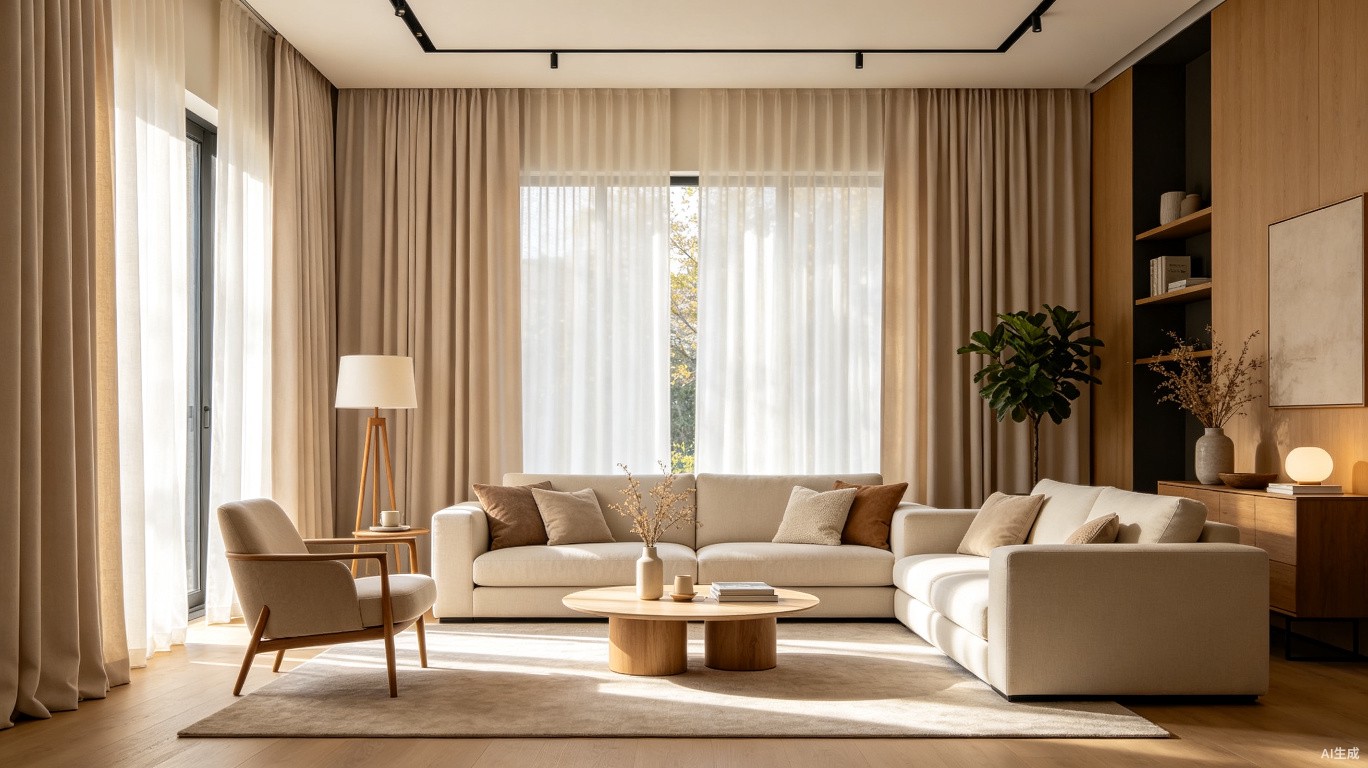

Curtains are often treated as an afterthought in living room design, but they are in fact one of the most impactful elements you can deploy. A well-chosen curtain treatment controls natural light, insulates against heat and cold, dampens sound, and frames the entire view out your window. Get them wrong, and even the most carefully furnished room feels incomplete. After consulting with interior designers and evaluating hundreds of real living room installations, we have compiled fifteen actionable tips that cover everything from fabric selection to smart home integration.
Fabric Selection and Light Control
1. Understand opacity levels before you buy. Sheer curtains filter roughly 30 to 40 percent of incoming light while preserving the view, making them ideal for living rooms that face east and receive gentle morning sun. Semi-sheer and semi-opaque fabrics reduce light transmission to about 60 percent, striking a balance between brightness and privacy during daylight hours. Blackout curtains, which use a triple-weave construction or a foam backing, block over 99 percent of light and are essential for west-facing living rooms that experience harsh afternoon glare. Many homeowners make the mistake of choosing a single opacity for every window in the house, but living rooms demand flexibility —consider pairing sheers with blackout drapes on a double rod for complete control.
2. Linen remains the most versatile curtain fabric for modern living rooms. It drapes beautifully with a relaxed, organic texture that softens hard architectural lines. A medium-weight linen in a neutral tone like oatmeal, flax, or warm gray works with virtually every design style from Scandinavian to mid-century modern. The trade-off is that linen wrinkles more readily than synthetic blends, but many designers consider this part of its charm. If you prefer a crisp look, look for linen-cotton blends or polyester-linen mixes that offer the visual texture of linen with improved wrinkle resistance. Prices for quality linen curtains range from $60 to $180 per panel depending on dimensions and brand.
3. Velvet curtains add depth and drama to a living room, particularly in jewel tones like emerald, sapphire, or deep burgundy. Beyond aesthetics, velvet has practical advantages: its dense pile provides excellent insulation, reducing heat loss through windows by up to 25 percent. Velvet also absorbs sound, making it a smart choice for living rooms with hardwood floors or high ceilings where echo is a problem. The primary maintenance concern is dust accumulation —plan to vacuum velvet curtains with an upholstery attachment every four to six weeks.
Mounting and Sizing for Maximum Impact
4. Mount your curtain rod 4 to 6 inches above the window frame, not directly on it. This single decision has more visual impact than almost any other curtain choice. Mounting the rod closer to the ceiling draws the eye upward and makes the entire wall —and by extension, the room —feel taller. In living rooms with standard 8-foot ceilings, this technique can make the ceiling appear 6 to 8 inches higher. For 9-foot ceilings, mount the rod 2 to 3 inches below the ceiling line. The rod should extend 8 to 12 inches beyond each side of the window frame so that when the curtains are fully open, they stack entirely on the wall rather than covering any glass.
5. Curtain panels should be 2 to 2.5 times the width of the window for proper fullness. A common mistake is ordering panels that are exactly the window width, which results in curtains that look stretched and flat when closed. For a 60-inch-wide window, you need a total curtain width of 120 to 150 inches —typically two panels at 60 to 75 inches each. This fullness creates the elegant, gathered look that defines well-dressed windows and also improves insulation by trapping more air between the fabric layers.
6. Floor-length curtains are almost always the right call for living rooms. Curtains that stop at the windowsill or fall a few inches below it break the visual flow of the wall and tend to look dated. Curtains should either kiss the floor —ending 0.5 inch above the surface —or puddle slightly with 1 to 3 inches of extra fabric pooling on the floor. The kiss-the-floor length feels crisp and modern, while a slight puddle adds a touch of traditional elegance. Avoid dramatic puddling of more than 4 inches unless you are designing a formal, classical living room, as it collects dust and makes vacuuming tedious.
Layering and Combination Strategies
7. The double curtain rod is one of the most underrated hardware investments in living room design. A double rod allows you to hang sheer panels on the inner rod and heavier drapes on the outer rod, giving you three lighting scenarios: sheers drawn for filtered light with privacy, drapes closed for complete darkness, or both open for maximum brightness. This layered approach is especially valuable in urban settings where privacy is a concern during the day but you still want natural light. Quality double rods from brands like Umbra or Kirsch cost between $40 and $120 and are a one-time investment that transforms how you use your living room throughout the day.
8. Roman shades paired with stationary curtain panels create a tailored, architectural look. The Roman shade handles practical light control —it can be raised or lowered precisely to any height —while the side panels soften the window frame and add color and texture. This combination works exceptionally well in living rooms with multiple windows on one wall, where a consistent treatment unifies the space without feeling monotonous. Choose a Roman shade fabric that complements one of the colors in your curtain panels for a cohesive design. Cordless Roman shades from brands like The Shade Store range from $150 to $400 per window depending on size and fabric.
Color, Pattern, and Style Considerations
9. Neutral curtains in warm whites, creams, and taupes create a serene backdrop that lets your furniture and art take center stage. This approach works brilliantly in modern living rooms where the architecture or furnishings are already strong visual statements. To prevent neutral curtains from feeling bland, choose fabrics with subtle texture —a slub weave, a slight sheen, or a tonal stripe adds interest without adding visual noise.
10. Patterned curtains act as a design anchor in living rooms with predominantly solid-colored furniture. A large-scale botanical print, a geometric design, or a subtle stripe can introduce pattern and movement to an otherwise subdued room. When choosing patterned curtains, consider scale carefully: patterns with motifs smaller than 2 inches across tend to read as texture from a distance, while large-scale patterns with 6- to 12-inch repeats make a bolder statement. If your living room already has a patterned rug or bold artwork, keep curtain patterns subtle or stick with solids to avoid visual competition.
11. In rooms with a strong color palette, curtains should either harmonize or provide deliberate contrast. For a harmonious approach, choose curtains two to three shades lighter or darker than your wall color —this creates depth without calling attention to the curtains themselves. For contrast, pull a color from your artwork, rug, or accent pillows and use it in the curtains to anchor the room. A navy curtain in a room with warm beige walls provides crisp definition, while terracotta curtains in a gray-toned living room introduce warmth and energy.
Hardware and Finishing Details
12. Curtain rod material and finish should be chosen with intention. Brushed brass and matte black are the two most versatile finishes for modern living rooms, complementing both warm and cool color palettes. Wood rods in a stained finish work well in transitional and traditional rooms but can look heavy in minimalist spaces. The rod diameter should be proportional to the window size: 1-inch rods for windows under 48 inches wide, 1.25- to 1.5-inch rods for windows between 48 and 72 inches, and 2-inch or larger rods for expansive windows and patio doors. Finials —the decorative ends of the rod —should relate to the room's overall style.
13. Curtain rings and grommets affect both function and style. Grommet-top curtains, where the rod threads through metal rings embedded in the fabric, create deep, uniform pleats and slide effortlessly, making them practical for curtains that are opened and closed daily. Pinch-pleat curtains, which use hooks attached to rings, create a more tailored, formal look with precise, evenly spaced folds. Back-tab curtains hide the rod entirely and create a clean, modern silhouette. For living rooms, choose a heading style that aligns with the overall formality of the space —grommets for casual, relaxed rooms and pinch pleats for more polished settings.
Smart and Motorized Solutions
14. Motorized curtain tracks have become dramatically more accessible in 2026, with complete systems starting around $200 per window. These systems connect to smart home platforms like Apple HomeKit, Google Home, and Amazon Alexa, allowing you to schedule curtain openings and closings based on time of day or sunrise and sunset. For west-facing living rooms, automated curtains that close at 3 p.m. during summer months can reduce cooling costs by up to 15 percent by blocking solar heat gain during the hottest part of the day.
15. For living rooms with unusually shaped windows —arches, bay windows, or floor-to-ceiling glass walls —custom curtain solutions are worth the investment. Curved curtain tracks from companies like Goelst and Silent Gliss can follow the exact contour of a bay window, while ceiling-mounted tracks disappear into the architecture for a minimalist look. Custom curtains for challenging window shapes typically cost 50 to 100 percent more than standard sizes, but the result is a living room that feels intentionally designed rather than awkwardly adapted.