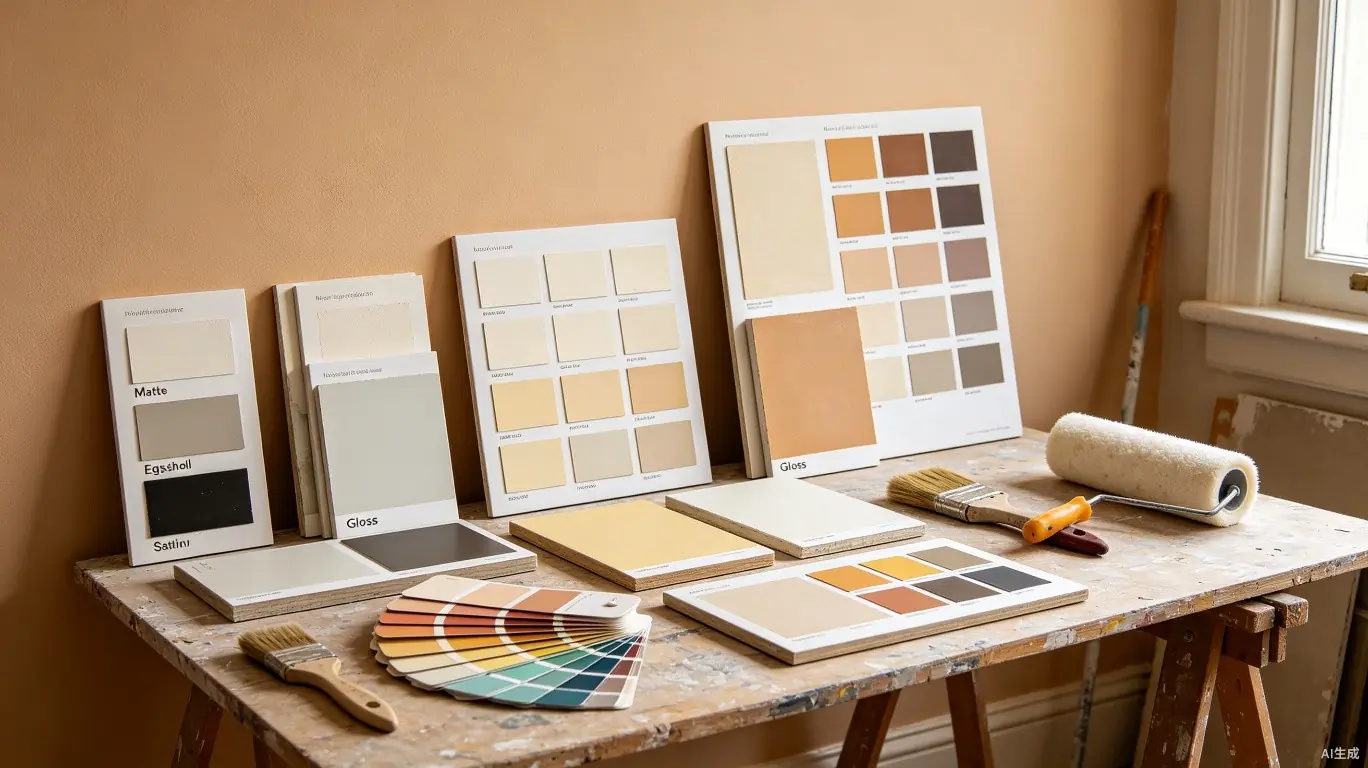

Choosing a paint color is the fun part. Choosing the right sheen — flat, matte, eggshell, satin, semi-gloss, or high-gloss — is the part that determines whether your paint job looks professional or amateur, lasts five years or fifteen, and hides or highlights every imperfection in your walls. Paint finish affects durability, washability, light reflection, and color perception, yet it receives far less attention than color selection in most renovation discussions. Here are fourteen expert tips to help you choose the right finish for every surface in every room.
Understanding the Sheen Spectrum
1. Flat finish (0 to 5 percent sheen) absorbs light rather than reflecting it, making it the most forgiving finish for imperfect walls. It hides Drywall seams, patched holes, and surface texture variations that would be glaringly obvious under a glossier sheen. The trade-off is minimal durability — flat paint cannot be scrubbed and will show marks from even light contact. Use flat paint on ceilings and in low-traffic rooms like formal living rooms and adult bedrooms where the walls are unlikely to be touched. Avoid flat paint in kitchens, bathrooms, hallways, and children's rooms.
2. Matte finish (5 to 10 percent sheen) bridges the gap between flat and eggshell, offering slightly more durability and a subtle, velvety appearance that has become the most popular wall finish in contemporary homes. Modern washable matte paints from brands like Benjamin Moore (Aura) and Sherwin-Williams (Emerald) can withstand light scrubbing, a significant advancement over traditional matte formulations that were nearly as delicate as flat. Matte is the recommended finish for living room and dining room walls in most homes.
3. Eggshell finish (10 to 25 percent sheen) is named for the subtle luster of an eggshell and represents the practical sweet spot for most wall applications. It provides enough durability to withstand occasional wiping without the noticeable shine of satin. Eggshell is the go-to recommendation for family rooms, hallways, entryways, and any space where walls may be touched or scuffed but where you do not want visible sheen. It is the most versatile finish for residential walls.
4. Satin finish (25 to 35 percent sheen) has a pearl-like luster that reflects light noticeably. Satin is more durable and washable than eggshell, making it suitable for kitchens, bathrooms, laundry rooms, and children's bedrooms. However, satin's reflectivity means it will highlight wall imperfections — every seam, bump, and patch will be more visible under satin than under eggshell or flat. For walls that are less than perfectly smooth, downgrade from satin to eggshell even in high-moisture areas and accept the slightly reduced washability.
Room-by-Room Recommendations
5. Kitchen walls and ceiling should be painted in satin or eggshell, never flat. Kitchen walls are exposed to grease aerosols, food splatter, and condensation, all of which require periodic cleaning. Satin is the top recommendation for kitchen walls because it can be wiped down with a mild cleaner without damaging the finish. For the kitchen ceiling, which is exposed to rising steam and grease, satin is also preferable to flat, even though ceilings are traditionally flat-painted. A satin kitchen ceiling can be wiped clean; a flat one will develop permanent grease stains.
6. Bathroom walls require satin or semi-gloss to withstand humidity, condensation, and frequent cleaning. Bathrooms without adequate ventilation — those with a window only and no exhaust fan — should absolutely use satin or semi-gloss, as flat or matte paint will develop water spots, mildew, and peeling within one to two years. For bathrooms with excellent ventilation (a 110+ CFM exhaust fan that runs for 20 minutes after each shower), eggshell is acceptable but satin remains the safer choice.
7. Ceilings are traditionally painted flat white to minimize light reflection and hide imperfections, but this is not an absolute rule. In rooms with very high ceilings (above 10 feet), a matte or eggshell white ceiling can bounce more light back into the room, reducing the sense of a dark, cavernous overhead void. In rooms where the ceiling is a design feature — tray ceilings, coffered ceilings, or ceilings painted a color other than white — the same sheen used on the walls creates a cohesive, enveloping look.
Trim, Doors, and Cabinetry
8. Baseboards, door casings, and window trim should be painted in semi-gloss (35 to 70 percent sheen). These surfaces are touched, kicked, and bumped regularly, and semi-gloss provides the durability and washability to withstand this contact. The subtle shine of semi-gloss trim also creates a pleasing contrast with eggshell or matte walls, giving the room a finished, deliberate look. For a more contemporary, less traditional aesthetic, satin trim is an acceptable alternative that reduces contrast with the walls.
9. Interior doors should match the trim sheen — semi-gloss is standard. Doors accumulate hand oils, scuffs, and dirt more than any other painted surface in the home. Semi-gloss enables easy cleaning and resists the buildup of oils from hands. For closet doors and passage doors that receive less contact, satin is adequate. For the front door interior face, which is seen by every guest and rarely touched, either semi-gloss for durability or high-gloss for dramatic impact are both valid choices.
10. Kitchen and bathroom cabinets require a durable, scrubbable finish that can withstand daily use. For painted cabinets, satin or semi-gloss are the standard recommendations. Semi-gloss provides the highest durability and is preferred for white cabinets that show dirt and grime. For dark-colored cabinets in navy, charcoal, or forest green, satin is often preferable — semi-gloss on dark colors can look plasticky and highlights every fingerprint and smudge. If DIY-painting cabinets, use a paint specifically formulated for cabinetry, such as Benjamin Moore Advance or Sherwin-Williams Emerald Urethane, which cure to a harder, more durable finish than standard wall paint.
Specialty Finishes and Techniques
11. High-gloss finish (70 to 85+ percent sheen) is a specialty tool, not an everyday choice. Its mirror-like reflectance makes it ideal for highlighting architectural details — a high-gloss front door, a high-gloss coffered ceiling, or high-gloss wainscoting — but it demands near-perfect surface preparation. Every single imperfection in the substrate and every brush mark in the application will be visible under high-gloss. Professional application with spray equipment and meticulous sanding between coats is essentially required for an acceptable result.
12. Dead-flat and ultra-matte finishes have emerged as a significant trend in 2026, pushed by brands like Farrow & Ball and Portola Paints. These finishes have a chalky, almost powdery appearance that creates extraordinary depth of color. The tradeoff is extreme delicacy — ultra-matte finishes mark with the slightest touch and cannot be cleaned. Reserve dead-flat finishes for accent walls, powder rooms, formal dining rooms, and other low-traffic spaces where the aesthetic reward justifies the practical limitations.
Practical Application Tips
13. The quality of the paint matters as much as the sheen. A premium eggshell paint from Benjamin Moore or Sherwin-Williams will outperform a budget satin from a big-box store in both durability and washability. Premium paints contain more solids (pigment and binder) and less water, resulting in a thicker, more durable film. Expect to pay $55 to $80 per gallon for premium paint versus $25 to $40 for budget paint — and expect the premium paint to cover in one to two coats versus three to four for budget, narrowing the total cost gap significantly.
14. Always prime before painting, and match the primer to both the substrate and the finish paint. New drywall requires a PVA drywall primer; previously painted walls need a high-hide primer if changing colors dramatically; stained or water-damaged areas need a stain-blocking primer; glossy surfaces need a bonding primer for adhesion. The $20 to $30 spent on the correct primer prevents the $200 to $300 in additional paint and labor required to fix peeling, staining, or uneven coverage caused by skipping primer. No paint finish, regardless of its quality or sheen, can compensate for inadequate surface preparation.